
It’s the summer of the semiquincentenial, and no self-respecting historical organization can escape without some acknowledgement of the American Revolution. Anniversaries, especially big-deal anniversaries like this one, are generally not a good occasion for good history. And indeed, the national celebration has been, for the most part, a complete disaster.
Many local organizations, on the other hand, have done a good job of salvaging something educational and interesting from the smoking mess of the Trump-directed celebrations. This is the story of the Little Compton Historical Society’s 250th project.
Semiquin possibilities
If you live in a place with a local Revolutionary War story, there’s a straightforward historical story to tell. If not, there’s a larger story to tell, considering how the ideals or the results of the Revolution are reflected in other times and places—in your town, in your city, in other historical periods, or today.
At the Little Compton Historical Society we considered both. The ideals seemed most interesting to me. We chose the title “Revolutionary Little Compton” to suggest that people in Little Compton did Revolutionary things—not just during the 1770s, but later, too: anti-slavery work, women’s rights, anti-War protests in the 1960s, no-King protests today. The ideals of the Revolution, defined broadly, still shape our country. There are some good stories to tell there.
The challenge with focusing on the Revolution itself was one that many local historical societies faced. Not much happened here. We have few artifacts from the period. There’s not much of a story to tell—or so we thought.
We chose, nonetheless, to focus on the Revolution. That was partly a political decision. The last few years, the Historical Society has worked on the Indigenous history of Little Compton, and we had a sense that it was time for something more traditional, less political.
Personal, Authentic, Local, and Relevant
And, It turns out that there was a story to tell. While Little Compton was not the scene of any great battle, Little Compton men and women and children were deeply affected by the War. We know that because of a new source for telling the story: the documents submitted to the US Government in the early 19th century as part of requesting a pension. Veterans had to describe what they had done in the War. They did that in great details. Widows, too, described their War, when they applied for a widow’s pension.
Those applications are at the National Archives, and online. Recent transcriptions by citizen archivists and AI tools means that they are searchable, and not difficult to read. Search for “Little Compton” in those records, and a remarkably detailed picture of the War, in the actual words of those who lived through it, appears.
That became our exhibit, and the basis of a book, and a performance. About eighty pension applications, many of them dozens of pages long, let us tell a deeply personal story of the War. We supplemented them with newspaper accounts, town council meeting minutes, diaries, and some accounts written by nineteenth-century local historians who interviewed veterans of the war.
These documents allowed us to do an exhibit that is authentic, local, and personal. Those three things, it seems to me, are essential for local history museums. Authentic means real things, usually artifacts. In this case, it meant real stories. Local is what local historical societies do best. They need to connect the local to larger stories, but unless they start with the local, it’s hard to get traction with a local audience. Personal is key for public history: people relate better to stories of people than to explanations of ideas.
But that’s not enough. Not everyone cares about the past, even if its local, personal, and authentic. It also needs to be relevant. That is, it needs to strike a chord with contemporary lives, perhaps even contemporary news. Writing a story of a town living under the constant threat of attack, of terror and trauma, at a time when the news was filled with images of the United States was attacking Iran, made clear its relevance.
We had, it turned out, a very interesting story to tell: the story of the Revolution in the words of those who lived through it. You can hear their voices. They’re individuals. Lives in Little Compton connect to national history. There are resonances—veterans, widows, refugees, terror—in the daily news.
One story, five ways
We took those personal stories and presented them in five ways, for different audiences. We did exhibits, wrote a book, and presented a range of programs. All were based on the research into the pension documents and other primary sources, and most of them presented those first-person stories to our visitors directly.
- An outdoor exhibit. About fifty banners on the outside of Historical Society buildings, and another dozen banners elsewhere in town. These banners were mostly quotes from the documents, each with a brief introduction.


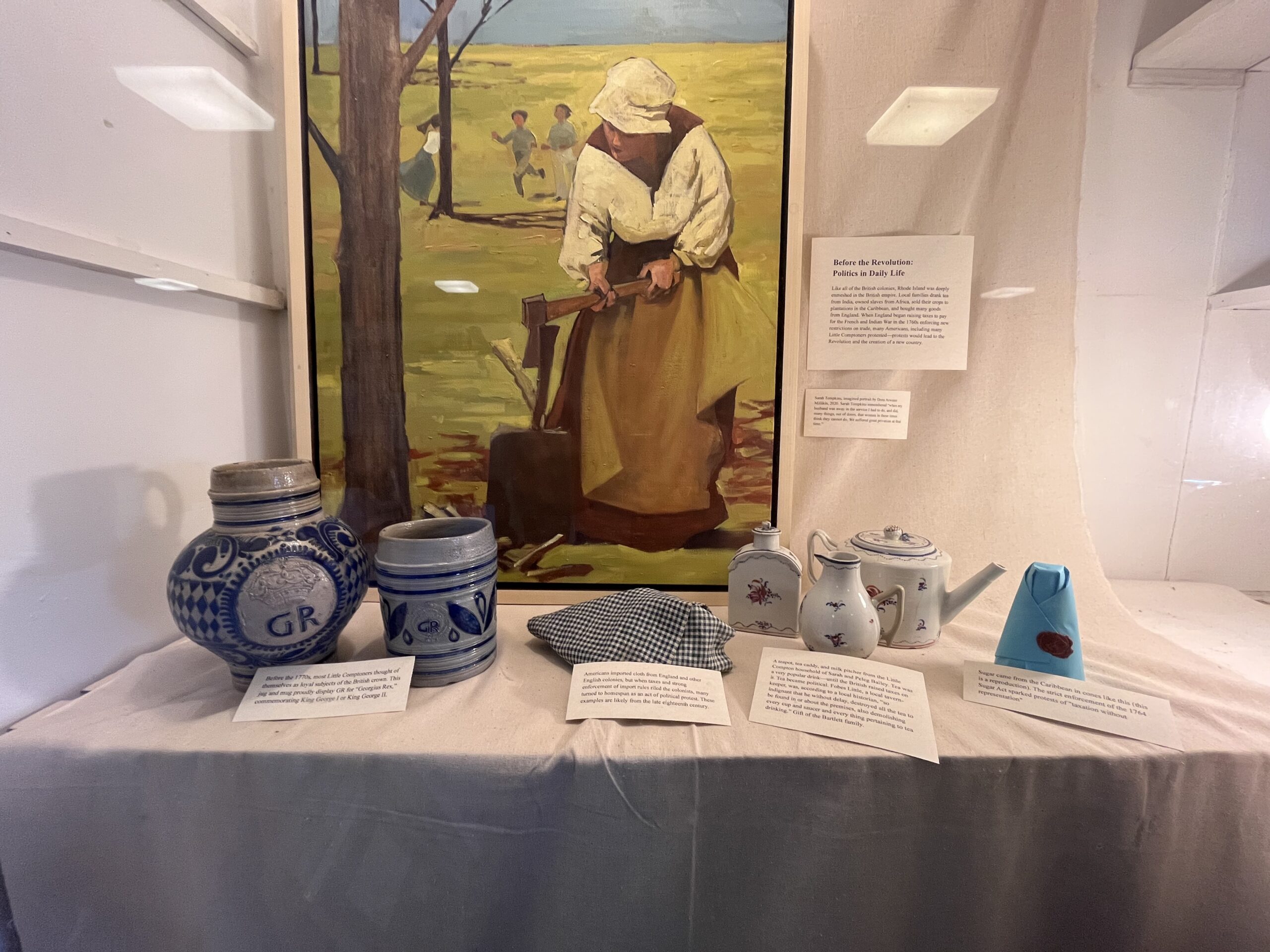
- An indoor exhibit. The Historical Society has very few objects from the Revolutionary era, and our main exhibit gallery had another exhibit that would be up through the summer. We used two small exhibit cases to show off those artifacts and to tell the story in a few words.
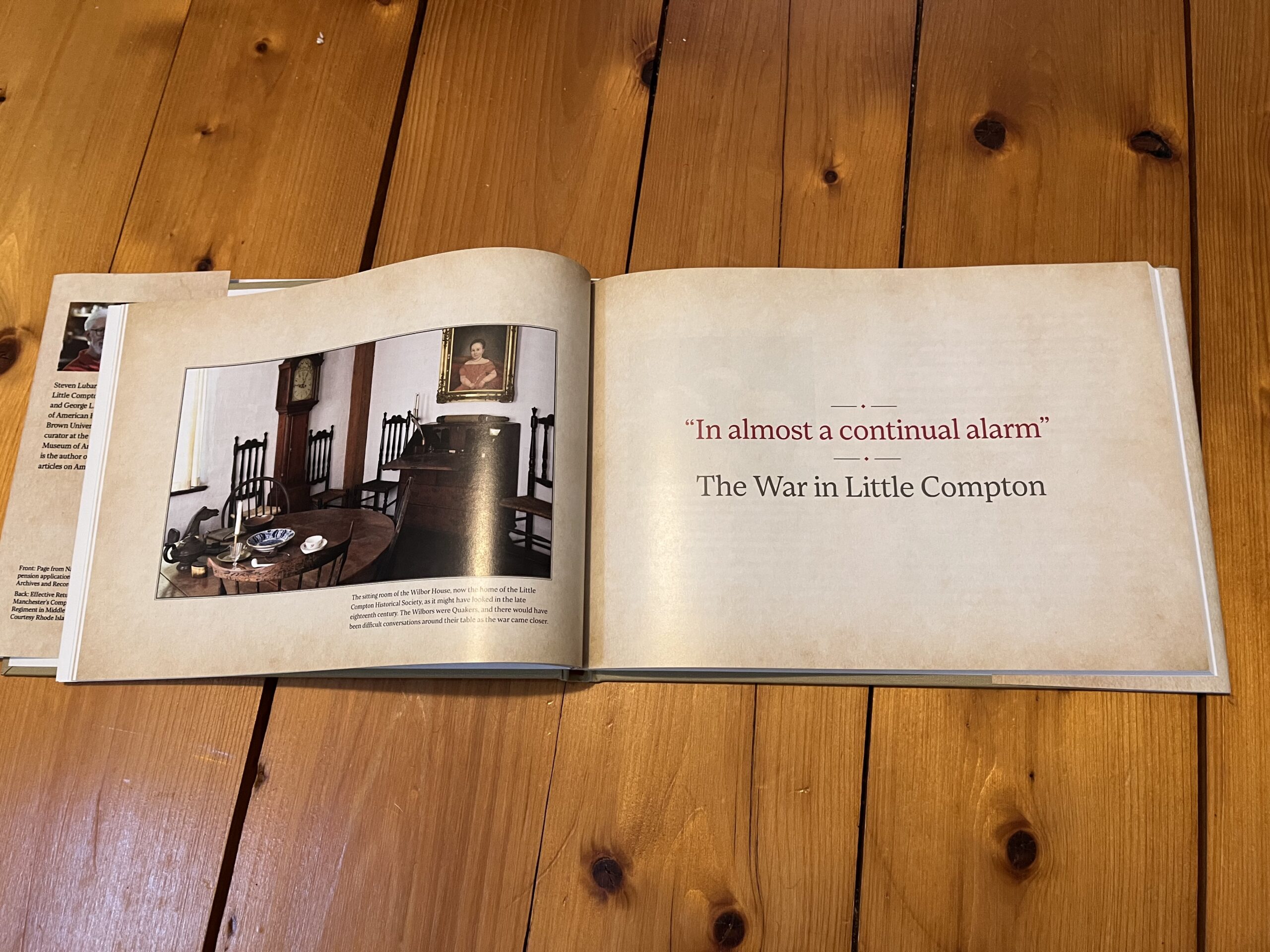
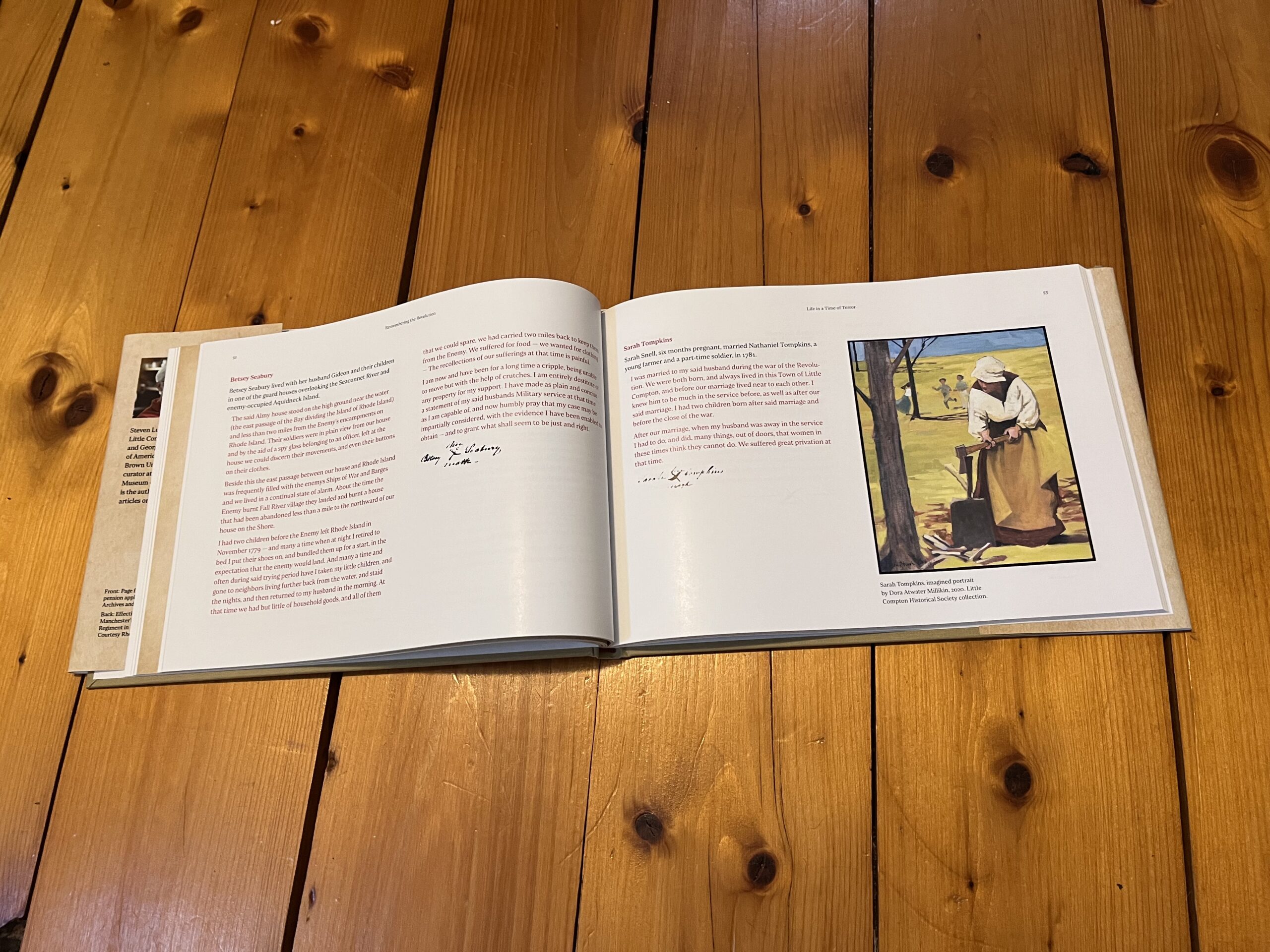
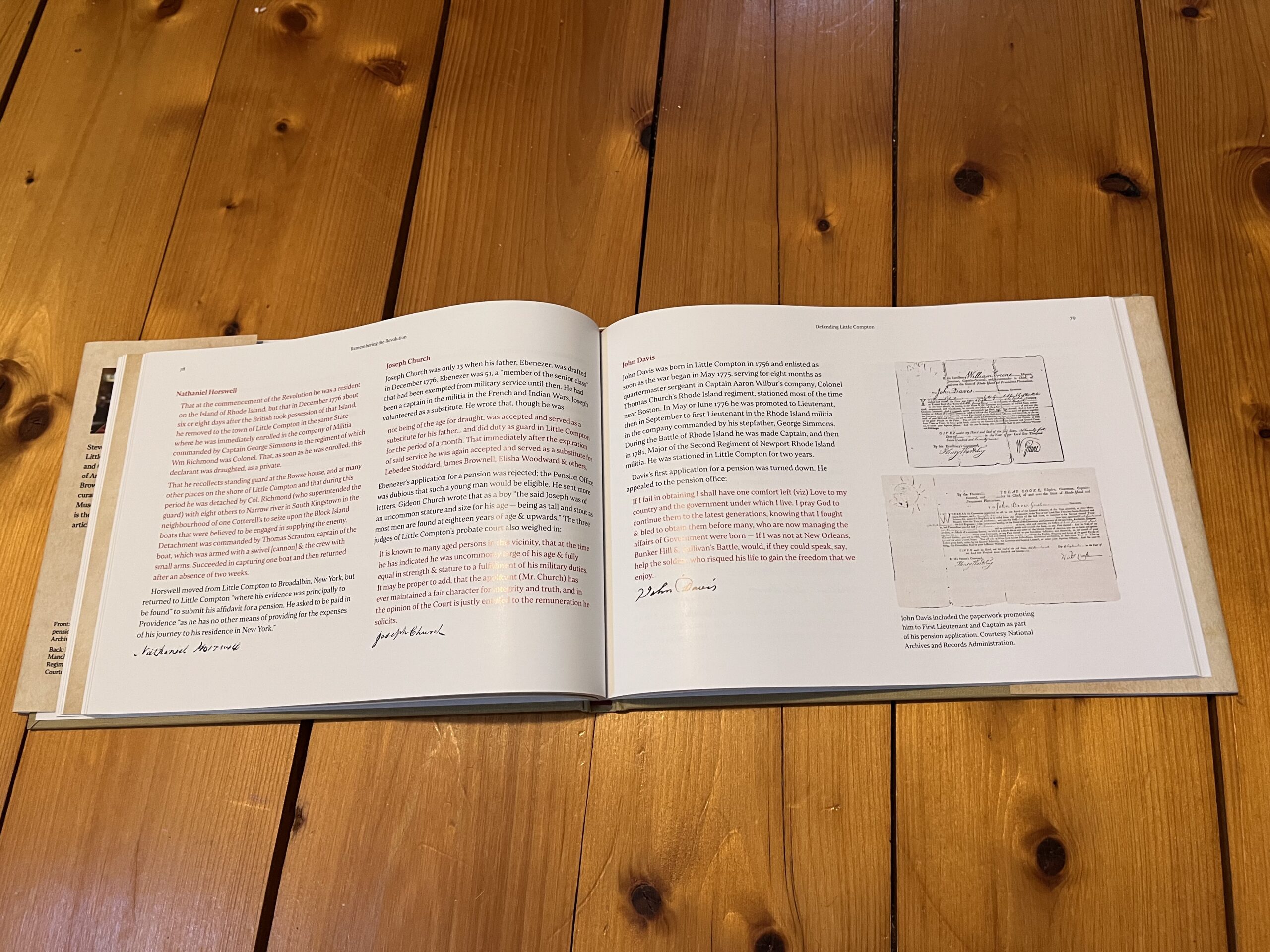
- A book. I’m very pleased with this book. There’s an introduction that describes the War in this area, and tells the story of the pension system. After that, it’s first-person voices. There are veterans and their widows, sometimes their children. When we couldn’t tell an important story in first-person—there are no pension records for Little Compton soldiers of color—we found other ways to tell their stories in a personal way.
- The book was, it seems to me, very like an exhibit. I got to work closely with the designer, cutting text to fit, finding images where he needed them. The book is in landscape format, which allows the individual stories to stay coherent, while also putting them in clear context. Buy it here, from LCHS! Or here, from Amazon.

- A performance. This was the most fun part of the project. We had all of these wonderful stories told in the voices of Revolutionary War veterans and their widows. Why not have them read aloud, with musical accompaniment. A small group of Little Compton readers, accompanied by Florrie Marshall, a talented violist, performed the piece at the Historical Society’s annual meeting, at the town’s United Congregrational Church. “Very Ken Burns” was the most common comment. It was quite moving, I thought. You can see the performance here.
- Programs. Colonial crafts for kids, from candle-making to writing with a quill pen. A visit from First Rhode Island Regiment reenactors. A lovely end-of-summer day with free red, white, and blue cupcakes. Programs for adults, too, including talks, book-signings, and more.


Concluding Thoughts
I’m pleased with the way Revolutionary Little Compton turned out. We added a significant new body of research to our local history, the detailed stories of scores of eighteenth-century Little Comptoners who had otherwise been lost to history. We connected those stories to bigger stories of American history. And we presented it all in a way that made it relevant, and interesting.
With thanks to Rich Cassenden for the wonderful photographs, and to Marjory O’Toole and Grace Leary, executive director and programs manager of the Little Compton Historical Society.
